New Jersey shoplifting laws classify offenses based on the value of stolen merchandise and impose penalties ranging from six months in jail for items under $200 to ten years in prison for theft exceeding $75,000. The laws also broadly define shoplifting to include concealing merchandise, altering price tags, removing security devices, and taking items without payment. First-time offenders may qualify for diversion programs that result in dismissal of charges, and convictions can be expunged after meeting specific waiting periods.
Beyond criminal penalties, you also face civil liability to store owners and strict time limits for prosecution. Property valued at under $200 is a disorderly persons offense handled in municipal court, while amounts of $200 or more constitute indictable crimes prosecuted in Superior Court.
At Lustberg Law Offices, LLC, New Jersey criminal defense attorney Adam M. Lustberg defends clients facing shoplifting charges throughout Bergen County and across the state. Our Bergen County shoplifting lawyer works to reduce charges, secure dismissals through diversion programs, and minimize the impact on your record where possible.
This guide explains what actions constitute shoplifting under New Jersey law, how the state classifies shoplifting offenses, the penalties for each level, whether first-time offenders face jail time, and available defenses. Call Lustberg Law Offices, LLC at (201) 880-5311 to speak with Adam M. Lustberg about your case.
What Actions Constitute Shoplifting Under New Jersey Law?
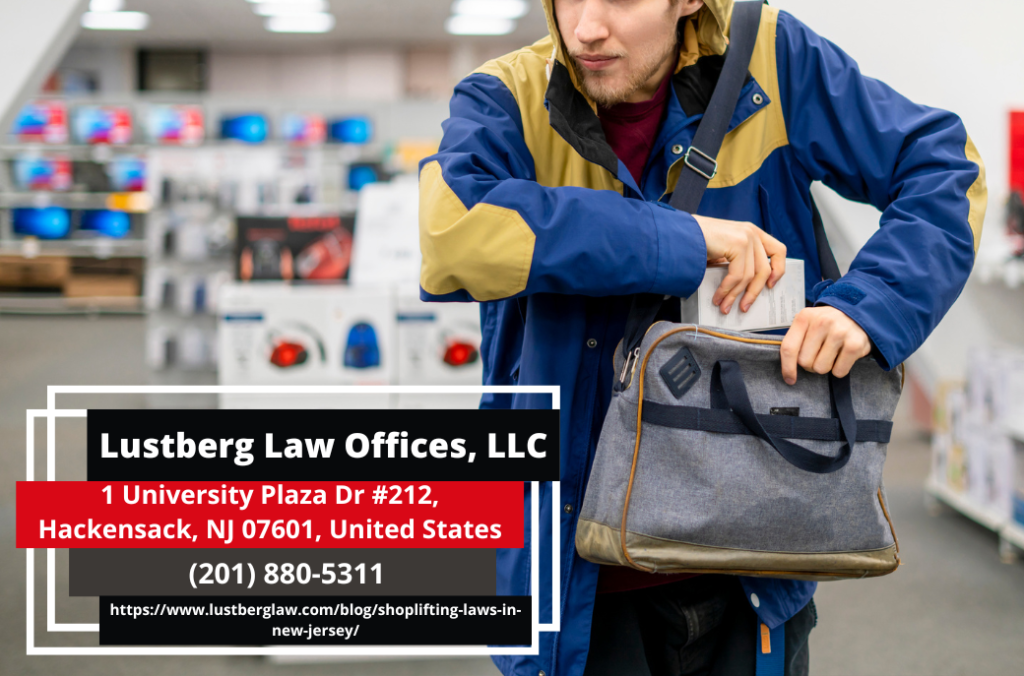
Under NJS 2C: 20-11, shoplifting encompasses more than simply walking out of a store with unpaid merchandise. The law recognizes several distinct actions as retail theft, each carrying the same potential penalties based on the property’s value.
Actions that qualify as shoplifting include taking merchandise from a store without paying, altering or removing price tags to pay less than the actual cost, transferring items from original packaging to cheaper containers, and concealing merchandise on your person or in bags while still inside the store. Removing or attempting to remove anti-theft devices also constitutes shoplifting under state law.
Proving Criminal Intent
The statute focuses on intent. Prosecutors must prove you intended to deprive the store of merchandise or payment. Accidentally walking out with an item you forgot to scan, or a genuine mistake about whether you paid, can serve as valid defenses when the evidence supports your version of events.
Retail establishments in Bergen County, including shopping centers in Hackensack and throughout the region, employ extensive surveillance systems and trained loss prevention staff who document suspected theft. Security footage, employee witness statements, and physical evidence, such as removed tags, become part of the prosecution’s case.
Contact Adam M. Lustberg to review the specific evidence in your case and identify potential defenses based on your circumstances.
How Does New Jersey Classify Shoplifting Charges?
New Jersey separates shoplifting offenses into two categories: disorderly persons offenses and indictable crimes. The classification depends entirely on the retail value of the stolen property.
Disorderly Persons Offense (Under $200)
When the merchandise value falls below $200, the charge is a disorderly persons offense. This is the least serious classification and is triedin municipal court rather than the Superior Court. However, a conviction still creates a permanent criminal record.
Fourth-Degree Crime ($200 to $500)
Property valued between $200 and $500 elevates the charge to a fourth-degree indictable crime. These cases move to the Superior Court and carry more severe consequences. The jump from being a disorderly persons offense to a fourth-degree crime represents a significant increase in potential penalties and long-term impact.
Third-Degree Crime ($500 to $75,000)
Shoplifting merchandise valued at $500 to $75,000 constitutes a third-degree indictable offense. This classification includes state prison time as a possible sentence and substantially higher fines. The wide range reflects everything from individual high-value items to organized retail theft operations.
Second-Degree Crime (Over $75,000)
When stolen property exceeds $75,000 in value, prosecutors file second-degree charges. This represents the most severe shoplifting classification and typically involves large-scale theft operations rather than individual incidents.
The value calculation includes all merchandise taken in a single incident or as part of a continuing course of conduct. Multiple small thefts from the same store or retail chain over time can be aggregated to reach higher dollar thresholds and more serious charges.
Adam M. Lustberg can examine how prosecutors calculated the alleged value and whether that calculation is accurate or subject to challenge.
Shoplifting Defense Attorney in New Jersey – Lustberg Law Offices, LLC

What Penalties Does New Jersey Impose for Shoplifting Convictions?
New Jersey imposes escalating penalties based on the offense classification. Each level has specific maximum sentence, fines, and potential additional requirements.
| Offense Level | Merchandise Value | Maximum Jail/Prison | Maximum Fine |
|---|---|---|---|
| Disorderly Persons | Under $200 | Up to 6 months | Up to $1,000 |
| Fourth-Degree | $200 to $500 | Up to 18 months | Up to $10,000 |
| Third-Degree | $500 to $75,000 | 3 to 5 years | Up to $15,000 |
| Second-Degree | Over $75,000 | 5 to 10 years | Varies |
Beyond incarceration and fines, courts may order restitution to reimburse the retail establishment for the full value of stolen or damaged merchandise. Judges can also impose community service requirements, probation terms, and mandatory counseling or theft education programs.
New Jersey law generally presumes non-incarceration for first-time offenders on lower-level charges. However, factors like prior criminal history, use of force or threats, involvement of multiple participants, or targeting vulnerable victims can increase the likelihood of jail time even for first offenses.
The penalties extend beyond the courtroom. A shoplifting conviction creates a permanent criminal record that appears on background checks. This record can affect employment prospects, professional licensing, educational opportunities, and housing applications.
Lustberg Law Offices, LLC can present mitigating factors to judges and prosecutors to argue for reduced penalties, alternative sentencing options, or dismissal, when applicable.
Will I Go to Jail for a First-Time Shoplifting Offense?
New Jersey maintains a presumption of non-incarceration for first-time shoplifting offenders, particularly on disorderly persons charges and lower-degree indictable offenses. This means jail time is not automatic, and many first offenders receive alternative sentences.
The law requires mandatory community service for shoplifting convictions: at least 10 days for a first offense and at least 15 days for a second offense. Courts typically impose community service, fines, and other conditions rather than incarceration for individuals with no prior criminal record. Factors that influence sentencing include the value of the merchandise, whether you have any prior record, your cooperation with law enforcement, your expression of remorse, and whether you made any statements admitting guilt.
First-time offenders charged with disorderly persons offenses often qualify for conditional dismissal or pretrial intervention programs. These diversionary programs allow you to complete requirements like community service, counseling, or restitution without a trial. Upon successful completion, prosecutors dismiss the charges entirely, leaving you with no conviction on your record.
However, certain circumstances can increase the likelihood of jail time even for first offenses. Using force, threats, or weapons during the theft; stealing high-value merchandise; operating as part of an organized retail theft ring; or having a substantial criminal history in other jurisdictions all work against non-incarceration presumptions.
The strength of your defense and the quality of your legal representation significantly affect outcomes. Prosecutors and judges respond differently to defendants who take immediate responsibility, make restitution promptly, and demonstrate genuine remorse, compared with those who deny the evidence or show no acceptance of wrongdoing.
Contact Adam M. Lustberg immediately after being charged to explore diversion program eligibility and begin building a defense strategy.
What Is the Statute of Limitations for Shoplifting Charges?
The statute of limitations establishes the maximum time prosecutors have to file criminal charges after an offense occurs. These deadlines vary based on the classification of the shoplifting charge.
For disorderly persons offenses involving merchandise valued at less than $200, the statute of limitations is one year from the date the offense is discovered. This means prosecutors must file charges within one year of when store security or law enforcement became aware of the theft, not necessarily when it occurred.
When the value exceeds $200, making the offense indictable, the statute of limitations extends to five years. This longer timeframe applies to all fourth-degree, third-degree, and second-degree shoplifting charges.
The discovery date may differ from the date of the actual theft. Retailers often uncover theft weeks or months later through inventory audits, video review, or investigations into organized retail theft. In these cases, the statute of limitations typically begins when the store or authorities reasonably should have discovered the offense, not when the act occurred.
Once the statute of limitations expires, prosecution is generally barred, and the state loses authority to bring charges for that offense. However, certain tolling provisions may pause or extend the limitations period, such as when a suspect leaves the state or intentionally conceals the crime.
If you received notice of charges filed outside the limitations period, Adam M. Lustberg can file motions to dismiss based on this statutory bar.
What Civil Liability Do I Face Beyond Criminal Penalties?
New Jersey law permits retail establishments to seek civil damages against shoplifters in addition to criminal prosecution. Civil liability exists separately from criminal penalties and is governed by its own legal standards.
Store owners in New Jersey may pursue civil action against shoplifters for the value of the merchandise, up to $500 if it was not returned in its original condition, and for any damages incurred during the shoplifter’s apprehension. These civil claims often arise in the form of demand letters from attorneys representing the retailer.
Because civil and criminal proceedings are independent, you may face civil liability even if criminal charges are dismissed, reduced, or result in an acquittal. Likewise, paying civil damages does not eliminate criminal exposure or guarantee favorable treatment in a criminal case.
Many retailers participate in civil recovery programs administered by law firms that specialize in shoplifting matters. Demand letters may arrive before criminal charges are filed and can create the impression that payment will prevent prosecution. However, paying a civil demand does not stop criminal proceedings and should not be confused with restitution ordered by a criminal court.
Restitution in criminal court typically compensates the retailer for the actual value of the stolen merchandise. Civil claims, by contrast, may seek additional damages, including costs associated with apprehension or investigation.
Key Takeaway: In addition to criminal penalties, New Jersey retailers can sue shoplifters for civil damages, including up to $500 for unreturned merchandise and related losses, with these claims proceeding independently of any criminal prosecution.
Consult Adam M. Lustberg before responding to civil demand letters to understand how payment might affect your criminal defense strategy.
What Defenses Can I Raise Against Shoplifting Charges?
Several defenses may apply to shoplifting charges, depending on the facts, available evidence, and witness credibility.
Common defenses include:
- Mistaken Identity: Surveillance footage may be unclear, and witnesses can misidentify suspects. Poor image quality or limited observation can create reasonable doubt.
- Lack of Intent: Shoplifting requires intent to steal. Honest mistakes, such as forgetting an item in a cart or being distracted by an emergency, may negate intent when supported by evidence.
- Medical Emergency: A sudden medical crisis that caused you to leave without paying may be a defense, particularly when supported by medical records or witness testimony.
- Improper Stop or Search: Evidence may be suppressed if security or police violated your rights, such as stopping you without reasonable suspicion, detaining you too long, or conducting an unlawful search.
- False Accusations: Employees may misinterpret innocent behavior or accuse someone to conceal errors or misconduct. Challenging credibility and inconsistencies can expose false claims.
- Mistake About Payment: If you reasonably believed the merchandise was paid for, such as relying on another person to complete payment, this may defeat criminal intent.
Your attorney evaluates the evidence, interviews witnesses, reviews surveillance footage, and identifies inconsistencies in the prosecution’s case. Honesty with your attorney about what occurred is essential. Attorneys can only build effective defenses when they know the complete and accurate facts.
Key Takeaway: Shoplifting defenses may include mistaken identity, lack of intent, medical emergencies, unlawful stops, false accusations, or payment misunderstandings, with each defense depending on the facts and supporting evidence.
Adam M. Lustberg can review all evidence, identify weaknesses in the prosecution’s case, and determine which defenses apply to your situation.
How Can I Get a Shoplifting Conviction Expunged?
Expungement seals your criminal record from public view, dramatically improving your employment and housing prospects. While background checks conducted by most employers and landlords will not reveal expunged charges, the process requires meeting specific eligibility requirements and following precise procedures.
To qualify for expungement of a shoplifting conviction, you must complete a waiting period of five years from the date of conviction for a disorderly persons offense. The waiting period for indictable offenses varies: fourth-degree crimes are generally eligible after five years, while higher-degree offenses require longer waiting periods or may be ineligible.
The expungement process is not automatic. You must file a petition with the court, serve notice on required parties, including prosecutors and law enforcement agencies, pay filing fees totaling approximately $75 plus attorney fees, and attend a hearing where the judge exercises discretion to grant or deny the request.
Courts consider several factors when evaluating expungement petitions. These include your conduct since the conviction, whether you completed all sentencing requirements, including restitution, whether you have any subsequent criminal charges or convictions, the nature and severity of the original offense, and your overall criminal history.
Once granted, the expungement order directs all agencies holding records to remove them from public databases. This allows you to legally state on most employment applications that you were not convicted of the offense. However, certain employers in law enforcement, judiciary positions, and some licensed professions retain access to expunged records.
The process typically takes four to six months from filing to final order. Working with an attorney ensures you meet all requirements, submit proper documentation, and present the strongest possible case to the court for granting relief.
Key Takeaway: New Jersey allows expungement of shoplifting convictions after a five-year waiting period for disorderly persons offenses, requiring a petition to the court and judicial approval, with successful expungement sealing records from most background checks and allowing you to deny the conviction legally.
Lustberg Law Offices, LLC can handle the entire expungement process, from eligibility evaluation through petition filing and representation at hearings.
Bergen County Shoplifting Legal Assistance & Defense
A shoplifting charge can affect your employment, education, and future opportunities. Even charges involving small amounts of merchandise create permanent records that appear on background checks and may disqualify you from jobs, professional licenses, or educational programs.
Adam M. Lustberg has defended shoplifting cases throughout New Jersey for over two decades. At Lustberg Law Offices, LLC, theft crime attorneys represent clients at Bergen County Superior Court in Hackensack, municipal courts across the region, and criminal courts throughout New Jersey. The firm challenges evidence, negotiates with prosecutors for charge reductions or dismissals, and pursues diversion programs that can keep convictions off your record entirely.
Call Lustberg Law Offices, LLC at (201) 880-5311 for a free consultation. The office is located at One University Plaza Dr, Suite 212, Hackensack, NJ 07601, and serves clients throughout Bergen County and across New Jersey. Adam M. Lustberg will review your case, explain your options, and begin building a defense strategy tailored to your circumstances.